

Latest Software Blog Posts
Bug Notification: Clause 4.1.8.23 Elastic Earthquake Load Incorrectly Included in ULS Factored Moments


Be aware of this for shear wall designs that are needed to behave elastically as per NBCC 2020 4.1.8.23
In cases where a bug or other issue is found in the MASS software, announcements are posted on the software’s known bugs page, as well as on this page here. It is always encouraged that suspected bugs are submitted by engineers through technical support.
As covered in the change notification linked here, MASS updates from NBCC 2015 to NBCC 2020. Included in this update is the ability for MASS to check if a shear wall behaves elastically. This is done in conformance with NBCC 2020 Clause 4.1.8.23. This bug notification in particular deals with an issue regarding how the elastic earthquake load inputted into MASS using Clause 4.1.8.23 results in incorrect factored moments.
Disclaimer: This post is exclusively intended to provide insight into the approach taken by the MASS design software in interpreting a NBCC 2020 code compliant seismic design. It is up to the professional discretion of the designer to input an appropriate layout, boundary and loading conditions, interpret the results, and determine how they should be incorporated into their designs. As per the end user license agreement (and also recommended within PEO’s guidelines for using engineering software), a tool cannot be considered competent and reliance on a tool does not relieve the user of responsibility.
As always, please do not hesitate to contact MASS technical support with any questions or concerns about any software results.
Summary
MASS performs NBCC 2020 Clause 4.1.8.23 performance checks for post-disaster (SC2, SC3, or SC4) and high-importance (SC3 or SC4) buildings, including elastic-behaviour verification (based on user-provided elastic earthquake load) and interstorey drift checks. This process is covered in the change notification linked here. Although the Clause 4.1.8.23 checks to confirm elastic wall behaviour are being performed correctly, MASS currently adds the user-provided elastic earthquake load (as determined per Clause 4.1.8.23) to the total earthquake load when calculating the factored moment for ULS analysis. This can be overly conservative and may drive designs toward flexural capacities significantly greater than what is actually required.
Discussion
Consider a post-disaster shear wall that is 3.5 m tall and 1.4 m long, with SC4 with the following loads:
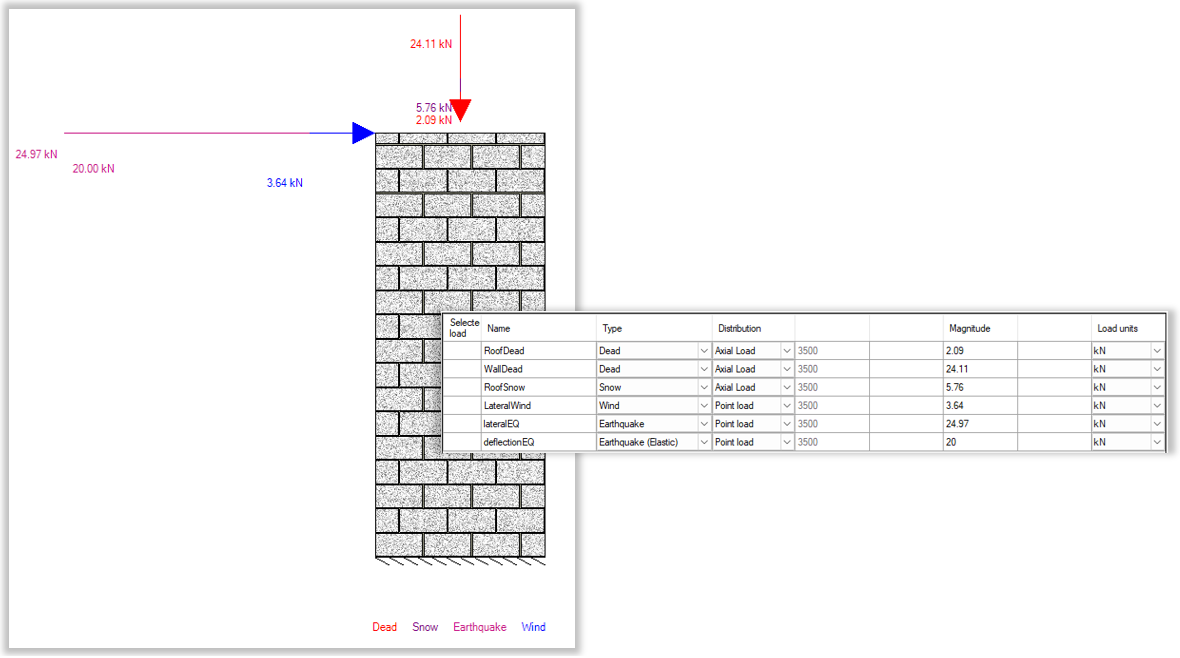
Based on these inputs, NBCC 2020 Clause 4.1.8.23 applies, and must be satisfied. An elastic earthquake load of 20 kN is calculated for use in these checks. MASS performs these Clause 4.1.8.23 checks correctly, and a detailed explanation of the methodology and its implementation in MASS can be found in the Change Notification linked here.
However, when the governing load case for ULS includes earthquake effects (which is typically expected), MASS incorrectly combines the earthquake load and the elastic earthquake load by adding them together when calculating the factored moment. For the example above, the correct factored moment is:
3.5m x 24.97kN = 87.395 kNm
MASS instead calculates:
3.5m x (24.97+20)kN = 157.395 kNm
In this scenario, the bug inflates the factored moment by approximately 180%, which can lead to designs being incorrectly flagged as failing or being unnecessarily overdesigned.
Note that the shear and deflection checks are performed correctly. Additionally, for multi-storey shear walls, this issue appears to affect only the top storey; the remaining storeys are designed correctly and do not exhibit this behavior.
Final Thoughts
When a wall is required to behave elastically, this bug will be encountered in MASS.
We have identified and resolved the problem and have released an updated version, MASS v4.3.1. The new release is now available for download linked here.
Still have questions?
CMDC is always evaluating the calculations and processes that are used by the MASS software. It is part of the ongoing technical support as the authorized service provider for National Masonry Design Programs (NMDP – publisher of MASS) that these issues continue to be identified and addressed as they are found. Please keep an eye out for new version updates which address issues such as these.
If there is any uncertainty regarding the calculations or results from the MASS software, please do not hesitate to contact MASS support. This software is a tool that must be well understood by the engineers performing the designs.